Did you know? |
|
(American Lung Association) |
All of us face a variety of risks to our health as we go about our day-to-day lives. Driving in cars, flying in planes, engaging in recreational activities, and being exposed to environmental pollutants all pose varying degrees of risk. Some risks are simply unavoidable. Some we choose to accept because to do otherwise would restrict our ability to lead our lives the way we want. And some are risks we might decide to avoid if we had the opportunity to make informed choices. Indoor air pollution is one risk that you can do something about.
In the last several years, a growing body of scientific evidence has indicated that the air within homes and other buildings can be more seriously polluted than the outdoor air in even the largest and most industrialized cities. Other research indicates that people spend approximately 90 percent of their time indoors. Thus, for many people, the risks to health may be greater due to exposure to air pollution indoors than outdoors.
In addition, people who may be exposed to indoor air pollutants for the longest periods of time are often those most susceptible to the effects of indoor air pollution. Such groups include the young, the elderly, and the chronically ill, especially those suffering from respiratory or cardiovascular disease.
Source Removal and Capture Provides Complete Cleaning and Decontamination of Air Ducts
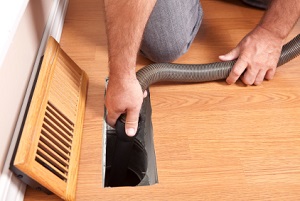
Cleaning should include: cleaning all of registers, inside the ductwork, the interior of the heating/ventilating system, the furnace fan, and the coils for an air conditioner or heat pump. Once the system is clean, a disinfectant can be sprayed throughout to kill any mold, bacteria or dust mites that remain.
A conventional HVAC duct system consists of a supply system of ducts to carry heated or cooled air from the furnace/air conditioner (air handler) to various parts of the home or building, and a return duct system to bring fresh air back to the air handler to be heated or cooled again. The supply network consists of main ducts, which carry air to smaller branch runs, which in turn carry air to the desired locations. The return network works in reverse.
State-of-the-Art Source Removal Duct Cleaning Process
The HEPA-AIRE process utilizes a HEPA-AIRE Portable Power Vac in tandem with a specially designed AIRE-SWEEP Portable Air Compressor and Agitation Tools for efficient state-of-the-art source removal duct cleaning. This method enables professional duct cleaners to remove contaminants from all parts of the duct system, regardless of location or type of duct. Yet it is simple to perform and requires only a limited amount of access holes. Here’s how it works:

What is ‘Source Removal and Capture’ Air Duct Cleaning?
Studies have shown that even a small amount of dirt buildup on HVAC system components can significantly reduce HVAC efficiency and increase energy consumption. According to university research and industry standards, complete removal of dirt, debris and other contaminants from the air duct systems is the most effective and acceptable cleaning and decontamination method for ductwork in both homes and commercial buildings.
C.A.R.E.’s duct cleaning process includes ‘source capture’:
Because the HEPA-filtered air exhausted back into the indoor environment from the vacuum is cleaner than many hospital operating rooms, there is no need to pull huge amounts of heated or cooled air out of the building and exhaust it outside, as must be done with gasoline or diesel-powered equipment.